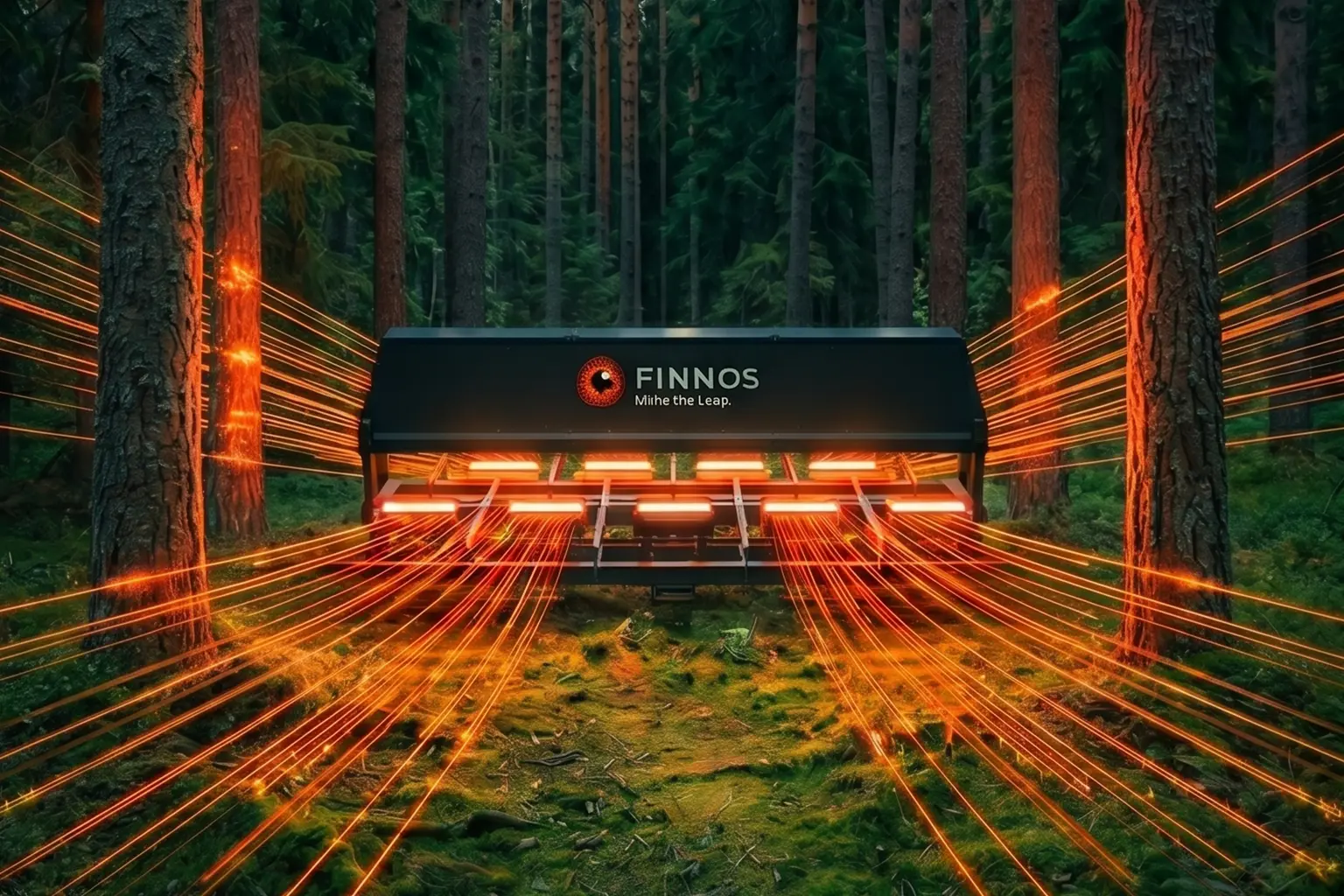
AI is an irreplaceable part of products, as it gives Finnos's systems a significant advantage. But how do AI systems actually work and what do they do?
The following key stages of the sawing line illustrate how we at Finnok use artificial intelligence:
- Our log scanners are based on laser camera and X-ray scanning, which collects information from every log that passes through the scanner. This produces a huge amount of data, which is then processed by an AI system. The AI combines the collected data and creates a unique fingerprint for each log (more on fingerprint technology later, keep an eye on our social media!). The most important benefit of AI is its speed, as without it, the process would be too slow. Currently, our log scanners can process 240 meters of logs per minute. This is an absolutely incredible speed.
- The scanned log continues its journey on the sorting line until it is kicked into the correct compartment. There's no need to wear out your own feet with kicking, as the AI system analyzes the data collected from the scan and calculates a result for the log, based on which it is expertly kicked into the right compartment. Easy peasy.
- When the log finds the right slot, it awaits sawing in two. In reality, it may be sawn into multiple pieces, as the next step is production optimization. The sawyer receives a virtual 3D image of each log, based on which an AI suggests how the log should be sawn to achieve optimal benefit. The system ensures that not a penny of the logs goes unutilized.
- The log's journey ends here, but it leaves behind valuable final product. How much will the logs ultimately yield? The efficiency of a batch can be measured with Finnos's log scanner. This scanner, which follows the line, again uses artificial intelligence for tasks such as defect detection and calculating the productivity of a production batch.
At Finnox, we are diving headfirst into the world of artificial intelligence with full force. And this is just the beginning, as our AI-specialized team works daily on improving existing systems and developing new AI solutions. See you in the future!